About Pages
Last updated: July 10, 2026
Overview
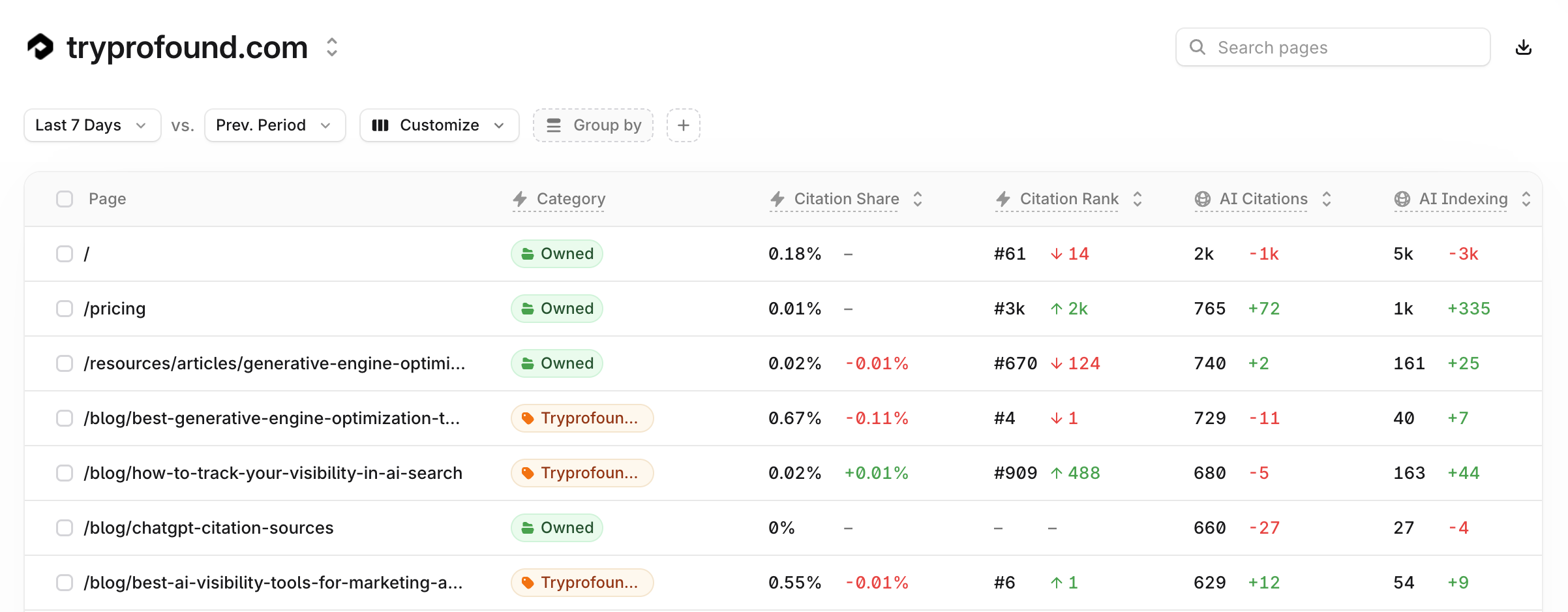
Pages gives you a clear view of how your content performs in AI search. It brings everything you need from Answer Engine Insights and Agent Analytics into one place to track the performance of your web pages. See how each page performs right now and how it's trending over time, all in a single view.
Learn more about Agent Analytics and Answer Engine Insights in Profound University: see the Agent Analytics lesson and the Analyze section in the Profound 101 course.
One view for how your content performs
Your content is the primary way you influence how your brand appears in answer engines. Until now, getting a clear picture of how it performs involved too many steps: the story for any one page was split between Answer Engine Insights and Agent Analytics. Even without Agent Analytics, digging into citation data in Answer Engine Insights takes several clicks and a clear idea of what you're looking for. That's a lot of effort to answer a basic question: is this content working?
Pages brings it all together. It centralizes the data Profound has about each piece of owned content: citation share from Answer Engine Insights, bot visits and benchmarks from Agent Analytics, Page Health, Bot vs. Human Readable Content, and content scores. From one place, see what content drives impact, spot opportunities to improve, and follow trends over time.
Working with Pages
Pages works for every customer, but what you see depends on whether Agent Analytics is configured for your account.
Without Agent Analytics
You get Pages with your Answer Engine Insights citation data, content scores, and AEO readiness scoring. Page Health, Bot vs. Human Readable Content, and Indexing are available too, so you can crawl your content, score how ready it is for answer engines, submit updates for indexing, and export rows. This removes a major activation blocker: act on your content right away, before any content delivery network (CDN) setup is complete.
With Agent Analytics
Adding Agent Analytics layers in live bot and referral activity from your server logs: AI citation bot traffic, AI indexing, AI training, AI agent visits, and human referrals, along with per-page benchmarks. This gives you the complete view of how AI systems both cite and crawl each page.
Key features
Unified page-level analytics dashboard
A single table lists every page with its key metrics in one row, combining citation data from Answer Engine Insights with live bot and referral data from Agent Analytics. The overview ranks pages by citation share and enriches them with bot visits (AI citation traffic, AI indexing, AI training, and AI agent visits), human referrals, tags, and category context. It's the fastest way to find the pages driving your visibility.
Citations breakdown
See exactly where and why a page is cited. Pages breaks a page's citations down by prompt, topic, tag, platform, region, persona, and even text chunks, each with citation share and citation rank, so you can tell which queries and audiences the page is winning.
Content analysis and recommendations
The Content tab analyzes a page's content and scores how ready it is for answer engines, with an overall score and a target zone. The score breaks down into factors like readability, content freshness, content structure, information density, and machine readability, and Pages turns each into specific optimization recommendations with the projected score impact of the change.
Network benchmarking
Your Page Ranking shows how a page's citations compare against roughly 3 million pages tracked across the Profound Network, scored from Poor to Great as a percentile. Benchmark against all sites or narrow to a peer group, so a raw number becomes a clear sense of how the page stacks up. This feature requires Agent Analytics.
Page Health
Page Health tells you whether your best content can load, render, and perform well enough for users, crawlers, and answer experiences to use it. It's an SEO-focused performance read on each page, sourced from Google Lighthouse and PageSpeed Insights. It covers core web performance metrics such as Largest Contentful Paint, Interaction to Next Paint, and Cumulative Layout Shift.
Bot vs. Human Readable Content
See the difference between what a person sees on a page and what an AI bot can access. Content rendered with client-side JavaScript often isn't visible to bots, so a page that looks complete to you can appear nearly empty to an answer engine. Pages flags the specific text blocks and headings hidden this way and recommends how to make them visible, so AI systems can find and cite the content that matters.
Indexing
Submit a page for indexing directly from Pages to prompt search engines to pick up new or updated content sooner. Indexing uses IndexNow, a protocol to request priority indexing across subscribing search engines. The protocol doesn't guarantee priority indexing. If the request is accepted, indexing can take a few days for large enterprises and up to a few weeks for smaller sites.